EUROPE · ECONOMY · MOVING ABROAD · 14 NOV 2026
Europe’s Richest Countries in 2026: Where Would You Actually Want to Live?
A country can be rich on paper while its typical household still faces eye-watering rent. Here's how to read Europe's 2026 GDP-per-person ranking without mistaking it for a salary chart—or a relocation recommendation.
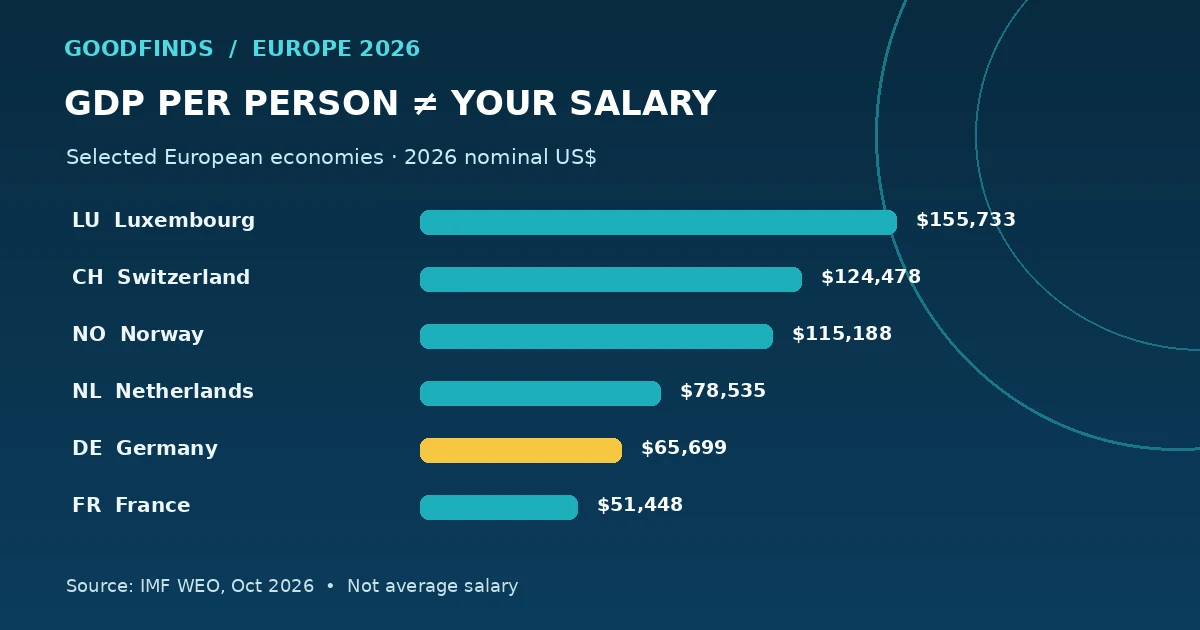
Selected countries: 2026 GDP per capita
Selected economies, not the complete European ranking.
| Country | 2026 projected nominal GDP per person | Notes for movers |
|---|---|---|
| Luxembourg | $155,733 | Cross-border workforce |
| Switzerland | $124,478 | High output; compare local costs |
| Norway | $115,188 | High output; location matters |
| Netherlands | $78,535 | Jobs and housing vary widely |
| Germany | $65,699 | Compare after-tax salary and rent |
| France | $51,448 | Check city-specific prices |
| Italy | $45,886 | Strong regional differences |
| Spain | $41,756 | Regional incomes and housing vary |
| Portugal | $34,815 | Lisbon differs from smaller towns |
| Poland | $31,186 | PPP changes the comparison |
Figures reflect 2026 IMF October projections in current US dollars.
Why this ranking matters—and what it does not measure
Visual Capitalist's November 12, 2026 feature ranks European economies by projected nominal GDP per capita, using the IMF's October 2026 World Economic Outlook. Liechtenstein leads at $230,417, ahead of Luxembourg at $155,733. Six economies exceed $100,000: Liechtenstein, Luxembourg, Ireland, Switzerland, Norway and Iceland. Those figures describe national economic production divided by population, not what a resident earns or can spend.
GDP counts output created inside a country. A small financial or business center can generate very high output per resident; cross-border workers and multinational accounting can further raise the number. If you are relocating, the figure is a starting point for questions about the economy—not a ranking of quality of life or a promise of high wages.
- Compare published wages for your actual occupation, not just the national GDP ranking.
- Calculate net take-home pay after income taxes and required social contributions.
- Check rent in the exact city where jobs or schools would be—not a countrywide average.
The 2026 numbers that matter for Spain, Germany and Portugal
Germany, Europe's largest national economy by total GDP, is 12th in the Visual Capitalist ranking at $65,699 per person. Spain is 21st at $41,756, while Portugal sits 26th at $34,815. France is 18th at $51,448 and Italy is 19th at $45,886. Those rankings describe economic output per resident, not unemployment, entry-level salaries, tax burden or household savings.
For a job seeker, Germany's larger high-value industrial and professional sectors may justify investigating specific cities and salaries. Someone retiring on an existing dollar pension may instead prefer a place where their money buys an agreeable lifestyle, weather suits them, and healthcare access is workable. The best choice may differ even for two people with identical incomes.
- Germany: compare gross job offers against rent, health insurance, taxes and commuting costs.
- Spain: compare regional labor markets and salaries with the cost of housing, transport and family life.
- Portugal: check the cost of Lisbon and Porto separately from less-touristed communities.
Why tiny countries dominate the top
Liechtenstein and Luxembourg are not typical large national job markets. Commuters from neighboring countries can contribute to GDP without being included in the resident population denominator, which tends to push per-person GDP upward. The Visual Capitalist analysis notes that almost half of Luxembourg's workers in 2025 lived outside Luxembourg.
Ireland is another useful caution. Global companies, intellectual-property accounting and aircraft leasing can increase measured GDP. Ireland uses modified gross national income (GNI*) to provide an additional picture of its domestic economy. These complications matter before anyone concludes that a ranking means residents of one country automatically enjoy twice the disposable income of another.
- A high ranking can reflect a specialized economic structure, not uniformly high household purchasing power.
- Small countries may also have housing or residency constraints that GDP does not show.
Nominal GDP versus purchasing power: the most important comparison
Nominal GDP per capita converts each country's output into current U.S. dollars using market exchange rates. Purchasing-power-parity (PPP) figures instead try to account for differences in local prices. The two metrics answer different questions: the first is useful for comparisons at prevailing exchange rates; the second can be a more relevant economic context for what money buys locally.
For example, Poland's projected nominal GDP per person is $31,186 versus Spain's $41,756. The gap in PPP terms is much narrower because goods and services generally cost less in Poland. Neither number tells you the actual cost of a particular apartment or the salary you would receive. To compare everyday life, use housing advertisements, regional price data and a written family budget.
- Always label figures as nominal or PPP, and say which year or forecast vintage they use.
- Do not compare a gross American salary with a European after-tax salary.
- Currency swings can change U.S.-dollar rankings without an equivalent change in local living standards.
A practical relocation scorecard beats a ranking
Create a one-page comparison for each possible country and city. Start with your legal right to live and work there, since a high salary is irrelevant if you do not qualify for a residence permit. Then estimate monthly net income, rent, utilities, insurance and health costs, transport, childcare or school expenses, and savings. Finally add harder-to-price factors: language, disability access, public services, climate, distance to relatives and the ease of traveling back to the United States.
A hypothetical example illustrates the method: one household might be offered more gross pay in a large German city but pay much more in rent; another might have lower wages in Spain but enjoy lower commuting costs. Neither scenario is a claim about today's actual prices. Plug in verified quotes and your own circumstances before deciding.
- Income: after-tax salary, pension or other documented recurring receipts.
- Housing: rent or mortgage, deposit, utilities and likely upfront fees.
- Administration: visas, residence renewals, driving licence, insurance and tax filing.
- Lifestyle: climate, schools, healthcare availability, language and community.
- Risk: exchange rates, contract stability and the size of an emergency fund.
Working, retiring and relocating are three different decisions
A professional considering Germany may prioritize recognized qualifications, employer demand and net pay. A family considering Spain may prioritize schools, residence eligibility, housing and daily routines. A retiree considering Portugal may prioritize the permitted residence route, pension taxation, healthcare and the affordability of a particular location. Europe's GDP ranking cannot settle any of these questions alone.
Be especially careful with headlines about 'Europe's richest country.' Wealth per person, median wages, disposable income, GDP per capita, inequality and household savings are separate concepts. A country can rank high on one metric and much lower on another. For a reliable comparison, cross-check the IMF with Eurostat, national statistics offices and actual local quotes.
- For job seekers: research employment demand and work authorization first.
- For retirees: model healthcare, taxes and reliable income before comparing scenery.
- For families: investigate local school access and housing before selecting a city.
What GOODFINDS readers should do next
Treat the data as inspiration for deeper research rather than a winner-takes-all league table. Choose three realistic destinations, verify the residence or work pathway for each, collect comparable housing listings and net-income estimates, and spend time on the ground before making long-term commitments. The strongest relocation plan combines official statistics with real costs and lived preferences.
For a deeper look, explore our guides on the German economy, Germany versus Spain, the cost of living in Spain, Germany's monthly budgets and retiring in Portugal. Those practical questions will tell you much more than any single GDP figure.
- Save the source date: IMF World Economic Outlook, October 2026 projections.
- Recheck official updates before publishing or making a financial decision.
- Never treat GDP per capita as a forecast of your personal income.
Sources and methodology
- International Monetary Fund, October 2026 WEO: nominal GDP per capita
- International Monetary Fund: PPP GDP per capita
- Visual Capitalist, November 12, 2026: Europe ranking
- Eurostat: Statistics explained
GDP is not salary, wealth or a cost-of-living index. Consult the original IMF projection and updated official statistics before making a relocation decision.
Join the conversation
Where would you choose to live in Europe? Share a firsthand cost-of-living experience—comments are moderated.
Join the conversation
Comments appear only after review.
Leave a comment