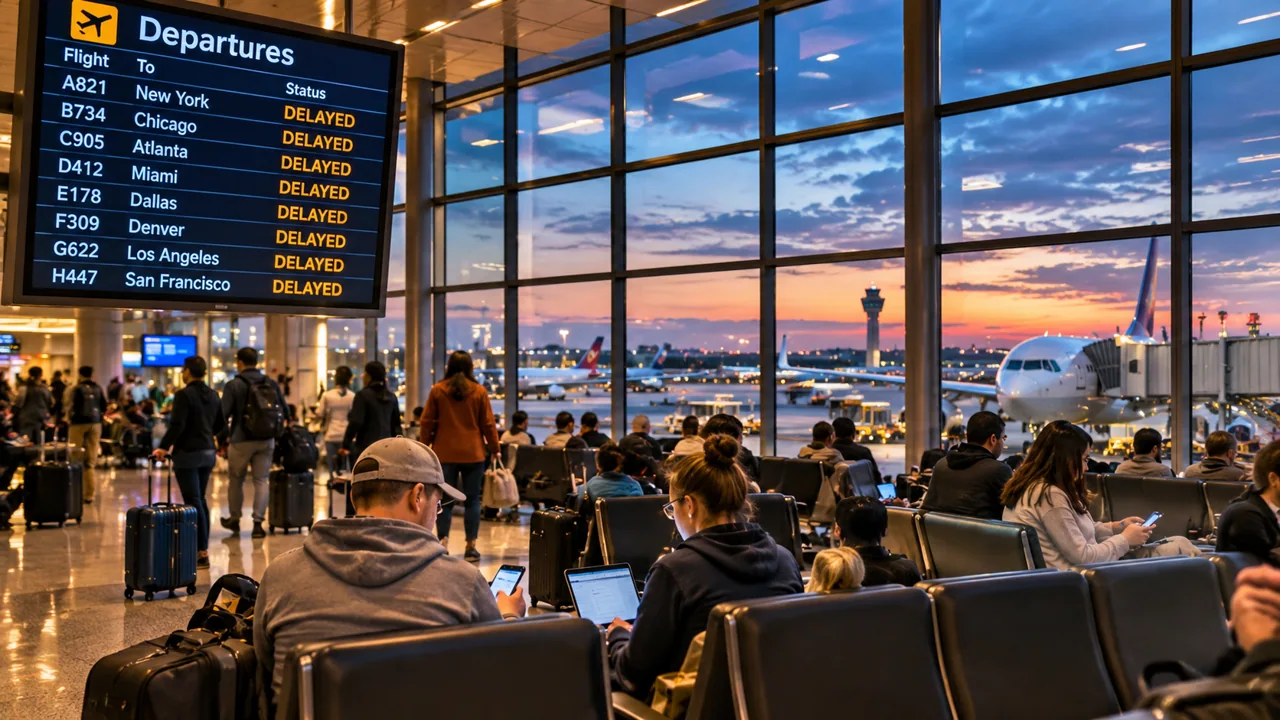
A rare safety shutdown grounded departures nationwide on November 13, 2026. Here is what happened—and a practical, fact-checked guide to protecting your trip if a nationwide or airport-wide restriction affects you.
Ground stops are safety orders, not automatically airline cancellations. Check your specific flight, understand whether you want a refund or rebooking, and do not assume the FAA restriction itself creates an automatic hotel entitlement. This news report is dated November 13, 2026.
What happened on November 13?
On Friday afternoon, November 13, 2026, the Federal Aviation Administration ordered a rare nationwide ground stop on departing flights. The order followed serious communication problems affecting air-traffic-control centers across the United States. The FAA described the measure as necessary for safety. Flights already in the air could continue to land, while international arrivals were to be handled case by case.
Initial reporting focused on telecommunications and control-center communications failures. Officials had not established a definitive cause when the first reports appeared, and travelers should not treat speculation about a cyberattack as established fact. This is a dated account of the November 13 event, not a live status report: even after a nationwide order ends, individual flight delays and missed connections can continue.
What is an FAA ground stop?
A ground stop is an air-traffic restriction, not simply a notice that your airline is running late. It can prevent departures to one airport or, in an extraordinary event, departures across the country. Aircraft already flying are managed separately. A ground-delay program is different: it meters flights into a congested airport, spreading out departure times rather than suspending all takeoffs.
The FAA does not decide whether your reservation gets refunded or which connecting itinerary your airline offers. Those questions are handled through the carrier, applicable passenger-protection laws, and sometimes your travel agent. Do not assume that an estimated FAA end time means your particular flight will depart then.
Your first 15 minutes: practical checklist
Open the airline app and check the actual flight number, not just the airport’s general delay board. Enable push notifications and capture a screenshot showing the delay or cancellation and its stated cause. Then check the FAA’s official status channels and the airport website for broader context. Airline staff remain your best source for the status of your own ticket.
Search for alternatives in the app while joining the customer-service queue. If needed, call the airline and use its chat at the same time, but do not confirm multiple incompatible changes. Keep your passport, medications, chargers, water and receipts accessible. Families should ask staff whether seating and accessibility arrangements transfer to the replacement flight.
- Check the airline app and take screenshots
- Join the rebooking queue before seats disappear
- Save receipts, booking numbers and airline messages
- Confirm connections, bags and family seating
Refund or rebooking: choose before clicking
Under U.S. Department of Transportation rules, if an airline cancels a flight and you choose not to travel or accept an alternative, you can be entitled to a refund to the original payment method regardless of the cause. A qualifying significant change or delay can trigger the same right. DOT regulations generally use arrival or departure changes of at least three hours for domestic itineraries and six hours for international itineraries, among other significant-change criteria. Check your specific itinerary.
If you accept and take the replacement flight, you normally cannot also claim a full refund for the original ticket. A voucher is not automatically your only choice when a cash refund is legally due. If you booked via an online travel agency, contact that agency as well; the responsible party and processing route depend on the merchant of record and applicable rules.
An airline may offer a free change or waiver before the flight is officially canceled. Read its date limits, destinations and fare conditions. Do not voluntarily cancel a nonrefundable flight merely because you fear it might be delayed: your options could improve if the airline later cancels or significantly changes it.
Request the earliest suitable rebooking and confirm it in writing.
Check whether the cancellation or significant change makes you eligible for a refund.
Hotels, meals and compensation: do not assume
A nationwide FAA restriction is generally not considered a disruption within the airline’s control. The U.S. DOT airline-service dashboard mainly summarizes voluntary airline commitments for controllable problems, so it does not guarantee hotel rooms, meal vouchers, or cash inconvenience payments because of this outage. Ask the carrier what it will provide anyway, especially during an overnight delay, and keep every receipt.
If you need accommodation, compare the total refundable rate before booking. Check your travel insurance or card benefits for delay expenses, but read exclusions carefully—air-traffic-control disruptions may have specific coverage terms. Travel insurance and statutory airline refunds are different benefits; one does not automatically replace the other.
Connecting flights: one ticket or two?
The biggest trap is a separate-ticket connection. If both legs are on a single protected booking and the airline disrupts the first segment, the carrier should generally arrange a way to complete the itinerary under its contract of carriage and applicable rules. If you independently bought another airline ticket, train, cruise, or hotel, those providers might treat your late arrival as your problem.
Call the second provider before its deadline if you suspect you cannot make it. Ask for a written exception or a no-show waiver and verify any baggage rules for the new route. Keep the first cancellation notice, both confirmation numbers, and evidence of when you requested help.
Flying between the United States and Spain or Europe?
EU Regulation 261/2004 may apply if your flight departs an EU airport, regardless of airline, or arrives in the EU from outside the EU on an EU carrier. It has different rules for rerouting, refunds, and assistance. Extraordinary circumstances can remove the right to fixed cash compensation but do not necessarily remove the duty of care when the regulation applies. Check the official Your Europe guidance rather than assuming that every flight touching Europe qualifies.
Example: a flight departing Madrid for New York generally falls within EU261 even if the airline is American. A flight from New York to Madrid on a U.S. airline normally does not qualify under the same EU rule just because it lands in Spain; it may still be subject to U.S. DOT refund requirements. A connecting itinerary can complicate the answer—look at the operating carrier and ticket structure.
Sample message to send the airline
Use the airline’s chat or email, replace the brackets, and ask them to reply in writing: “My flight [number] on [date] was affected by the November 13 FAA ground stop. Please confirm whether it is canceled or significantly delayed, my earliest available rebooking to [destination], and my refund options if I decline alternate travel. Please also confirm whether meals or overnight assistance are being offered.”
Before buying another ticket: final checks
Re-check the status at the airline and the FAA; verify whether you would lose your original booking by accepting a new itinerary; compare arrival airport, baggage, layover, cancellation terms and ground transportation; and document the total cost. A last-minute replacement might arrive earlier but cost much more or leave you with two active reservations. If you can wait, ask your airline to secure a new seat first.
Bottom line: this story describes the November 13, 2026 disruption. It cannot confirm whether a ground stop remains active when you read it. For real-time status, rely on official FAA notices and your airline’s flight status; for refunds, start with DOT or the applicable EU passenger-rights rules.
Official guidance and reporting
- Upgraded Points: November 13 report ↗
- Reuters: FAA nationwide halt ↗
- FAA: current air-traffic advisories ↗
- U.S. DOT: refunds and significant delays ↗
- U.S. DOT: airline passenger commitments ↗
- EU: air passenger rights ↗
Reporting reviewed November 13, 2026. Flight status changes continuously; confirm with the airline. This independent GOODFINDS guide is not affiliated with the FAA, airlines, or Upgraded Points.


What’s your experience?
Got a useful correction, a local tip, or your own story? Share it with the community.
Reader notes
Comments are reviewed before appearing publicly. Please keep it kind, relevant, and free of personal information.
Leave a comment